



Latest Posts




This is the secret that separates amateur sellers from professionals.
After creating individual listings for different color variants, you MUST group products with the same article number but different colors together.
Here’s what most sellers do wrong: They create separate listings for a blue shirt, a white shirt, and a black shirt—even though it’s the exact same product in different colors. Result? Three weak listings competing against each other instead of one powerful listing dominating search results.
Let me show you exactly how top brands execute this:
Here & Now’s Perfect Grouping Execution:
Here&Now Blue Slim Fit Checked Cotton Casual Shirt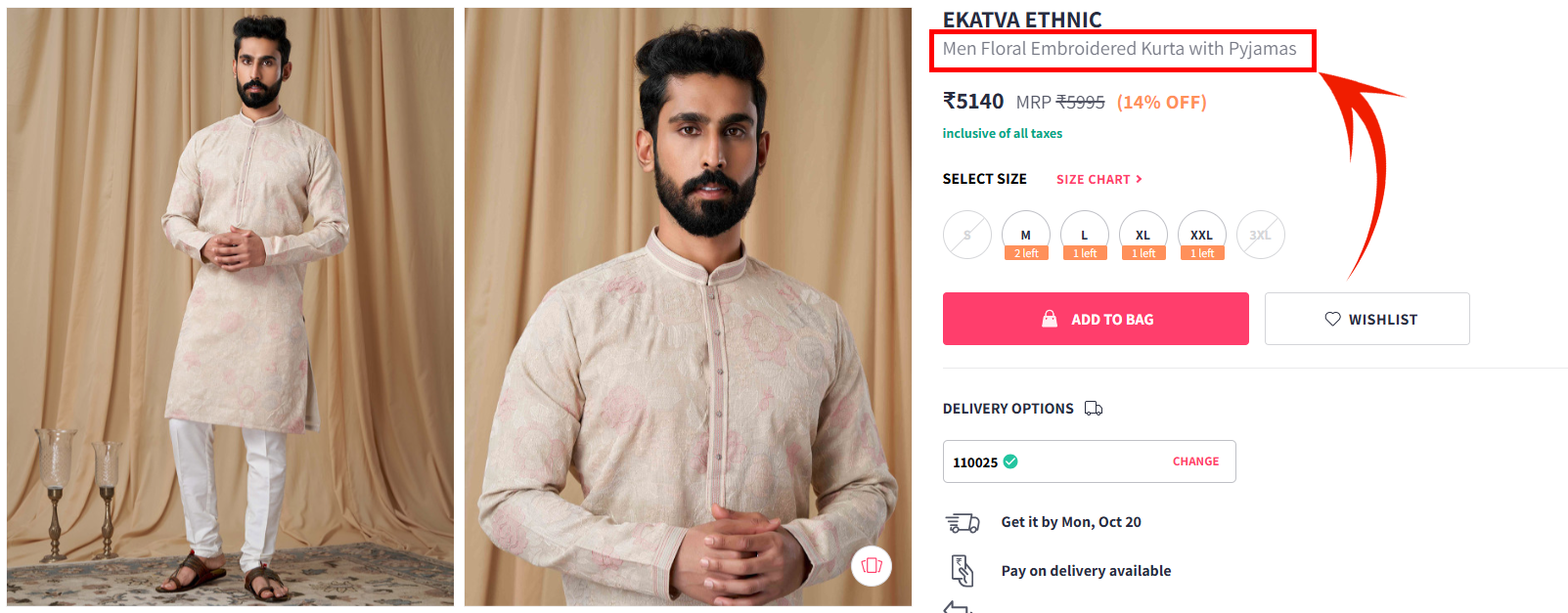
When you open this listing, look directly below the product images. You’ll see something critical that most amateur sellers miss entirely.
The Color Variant Selector:
Notice how Here&Now displays multiple color options right there on the same listing page:
- Blue (the current selection)
- White
- Pink
- Green
- Navy Blue
- And potentially more variants
Here’s the magic happening behind the scenes:
All these color variants are grouped under ONE master listing with the same:
- Article/Style number
- Product specifications (fit, material, design)
- Brand name (Here&Now)
- Product category (Casual Shirts)
- Size options
Only the color differs.
Why This Grouping Strategy is Pure Gold:
- Unified Search Visibility
When a customer searches for “slim fit checked cotton shirt,” Here&Now’s listing appears ONCE with all color options, not scattered across multiple search result pages.
Impact:
- Single powerful listing with combined reviews and ratings
- Higher authority in Myntra’s algorithm
- Better search ranking position
- Instead of: Blue shirt on page 3, white shirt on page 7, pink shirt on page 12
- Customer Experience Optimization
Look at what happens when a customer clicks on the blue shirt:
- They see the blue variant
- They notice “More Colors” displayed prominently
- They can click and switch to pink, white, or green without leaving the product page
- They don’t need to search again or scroll through results
This creates a seamless shopping experience that:
- Increases time on listing (algorithm loves this)
- Reduces bounce rate (customers don’t leave to find other colors)
- Boosts conversion rate (choice increases purchase likelihood)
- Decreases cart abandonment (customers find everything in one place)
- Consolidated Reviews & Ratings
Here’s where grouping becomes exponentially powerful:
When colors are properly grouped:
- All reviews across ALL color variants appear on the SAME listing
- Ratings are aggregated (a 4.3-star rating from 500 reviews is stronger than 4.5 stars from 50 reviews)
- Customer photos from all variants display together
- Social proof multiplies dramatically
Example:
- Without grouping: Blue shirt has 30 reviews, white shirt has 25 reviews, pink shirt has 20 reviews (75 total reviews split across 3 weak listings)
- With grouping: ONE listing shows 75 reviews with multiple color photos (algorithm recognizes this as a popular, trusted product)
- Inventory & Availability Benefits
When a customer searches and the blue variant is out of stock in their size:
- Without grouping: The listing might not appear at all, or shows “Out of Stock” → Customer bounces
- With grouping: Customer sees the product, clicks, and discovers the white variant IS available in their size → Sale happens!
This dramatically reduces lost sales opportunities.
- Algorithmic Ranking Advantage
Myntra’s algorithm evaluates listing performance based on:
- Total engagement (clicks, views, time on page)
- Conversion rate
- Customer satisfaction (reviews, ratings)
- Return rate
- Add-to-cart frequency
Grouped listings accumulate ALL this positive data in ONE place, creating a compounding effect that pushes the listing higher in search results.
How to Execute Perfect Grouping Like Here&Now:
Step 1: Create Individual Listings for Each Color
- Upload blue shirt with blue product images
- Upload white shirt with white product images
- Upload pink shirt with pink product images
Step 2: Use the SAME Article/Style Number
- Critical: All variants must share the exact same article identifier
- Example: If blue shirt is “HRN-CAS-2024-001”, white and pink MUST also be “HRN-CAS-2024-001”
Step 3: Ensure Identical Product Specifications
- Same fit (Slim Fit)
- Same material (100% Cotton)
- Same design (Checked Button-Down)
- Same size range (S, M, L, XL, XXL)
- Same price point (or strategically varied)
Step 4: Request Myntra to Group the Variants
- Through your seller dashboard, submit grouping request
- Myntra’s catalog team reviews and links the color variants
- Once approved, all colors appear under one master listing
The Visual Indicator of Successful Grouping:
On Here&Now’s listing, you’ll see small color swatches or thumbnails showing:
- Current selection (blue) highlighted
- Alternative colors (white, pink, green, navy) as clickable options
- Instant color switching without page reload
When you click a different color:
- Product images update to show that color variant
- Title updates to reflect the new color
- Size and availability update specific to that color
- URL might change slightly, but customer stays on the same listing structure
- Reviews and ratings remain unified
Common Grouping Mistakes to Avoid:
Mistake #1: Using Different Article Numbers
- Blue shirt: HRN-001
- White shirt: HRN-002
- Result: Myntra sees these as completely different products, won’t group them
Mistake #2: Slight Specification Differences
- Blue shirt: “Slim Fit”
- White shirt: “Regular Fit”
- Result: These are genuinely different products, shouldn’t be grouped
Mistake #3: Inconsistent Pricing
- Blue shirt: ₹999
- White shirt: ₹1,499
- Pink shirt: ₹799
- Result: Confuses customers, reduces trust, weakens the listing
Mistake #4: Grouping Unrelated Products
- Trying to group a checked shirt with a striped shirt just because they’re the same color
- Result: Customer dissatisfaction, high return rates, algorithmic penalty
Pro Strategy from Top Sellers:
Here’s what brands like Here&Now do that most sellers miss:
Strategic Color Sequencing:
- They list the best-selling color FIRST (often neutral colors like blue or white)
- High-quality images for ALL color variants (not just the primary)
- They ensure at least 3-4 color options are available (increases choice appeal)
- They keep similar pricing across variants (reduces decision friction)
Seasonal Rotation:
- They might feature bright colors (coral, mint, yellow) as primary during summer
- Switch to deep colors (navy, maroon, forest green) during winter
- This keeps the listing fresh and relevant throughout the year
Limited Edition Tactics:
- Introduce a new color variant to an existing successful listing
- Leverage the established reviews and ratings
- New color benefits from the listing’s existing search ranking
Here’s a sobering statistic: 75% of online shoppers rely on product images to make purchasing decisions.
In fashion e-commerce, your images aren’t just supporting content—they ARE your product until it arrives at the customer’s door.
The Professional Product Shoot Formula
Let’s talk about something most sellers get catastrophically wrong: image context confusion.
Common Mistake: You’re selling jeans, but your model wears the jeans with a printed shirt, leather jacket, and branded sneakers. Result? Myntra’s algorithm gets confused about whether you’re selling the jeans, the jacket, the shirt, or the shoes.
Here&Now’s Perfect Product Photography Execution: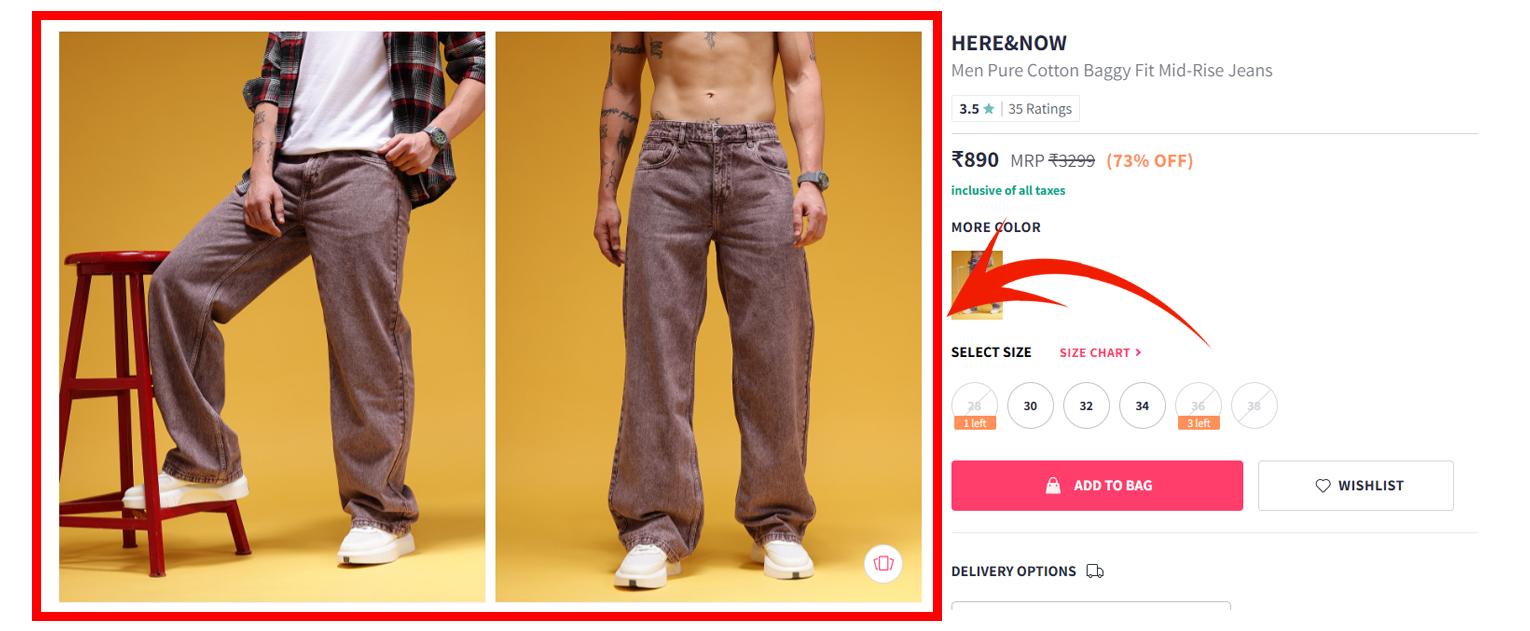
When you click on this listing, study their image gallery carefully. This is EXACTLY how professional sellers optimize product photography.
Image 1 – The Clean Primary Shot:
- Pure white background (#FFFFFF) – no distractions
- Model wearing ONLY the jeans with a plain white basic tee
- Full-length front view showing the entire product
- Jeans take center stage – 85% of the frame
- Perfect lighting with no harsh shadows
- True-to-life color representation (blue denim appears exactly as it is)
Why this works: The algorithm instantly recognizes this as “men’s jeans” with zero confusion. Customers immediately see the fit, wash, and style.
Image 2 – The Back View Detail:
- Same clean white background
- Shows back pocket design and stitching
- Reveals brand patch placement
- Demonstrates how the jeans sit at the waist
- Model still wearing only the jeans with neutral tee
Customer benefit: Shoppers can see the complete product from all angles, reducing uncertainty and return likelihood.
Image 3 – The Side Profile Shot:
- Showcases the “baggy fit” mentioned in the title
- Demonstrates leg opening and overall silhouette
- Shows how fabric drapes naturally
- Still maintains the clean, uncluttered aesthetic
Here’s the genius: From this angle, customers understand EXACTLY what “baggy fit” means for this product.
Image 4 – The Close-Up Detail Shot:
- Extreme close-up of the denim fabric weave
- Shows button and rivet quality
- Reveals stitching precision
- Demonstrates fabric texture
Why this matters: Premium shoppers want to see material quality. This builds trust and justifies the price point.
Image 5 – The Styled/Lifestyle Shot:
- Here&Now adds context with complete styling
- Model shown in a casual setting
- Jeans paired with accessories to show versatility
- Demonstrates real-world wearability
The strategic sequence: Clean product shots FIRST (for algorithm and clarity), lifestyle shots AFTER (for inspiration and conversion).
The Key Principle Here&Now Masters:
Every element in the first 4 primary product images is either:
- The product itself (the jeans), OR
- A minimal, neutral supporting element (plain white/grey tee) that doesn’t confuse the algorithm
The model isn’t wearing:
- Branded shoes that compete for attention
- Printed shirts that confuse the product category
- Jackets or layers that obscure the jeans
- Statement accessories that distract
The Product Shoot Should Be Good – Here&Now’s Formula:
Detailing of Product Must Be Clear:
- Close-up shots show fabric texture
- Stitching quality is visible
- Hardware (buttons, zippers) is photographed in detail
- Wash and fade patterns are accurately represented
The Model Isn’t Selling Multiple Products:
When you look at Here&Now’s listing, you never question what’s being sold. It’s crystal clear: JEANS.
Creative Images Come AFTER Primary Shots:
Notice in the Here&Now gallery – the lifestyle and styled images appear AFTER the clean product documentation. This is strategic:
- Images 1-4: Clean product documentation (algorithm optimization + clarity)
- Images 5-7: Styled/lifestyle shots (conversion optimization + inspiration)
Creative images include:
- Full outfit styling with accessories
- Environmental context (café, street, office)
- Multiple ways to wear the product
- Seasonal styling suggestions
These give the “full context to the feel” without confusing the algorithm during its initial product categorization.
Technical Requirements That Here&Now Nails:
- High resolution (clearly above 1000px width)
- Consistent lighting across all shots
- Professional color grading
- Product fills 85-90% of frame in main shots
- Sharp focus with no blur
- Color accuracy matches actual product
Here’s something shocking from my 15 years of experience: More than 50% of brands and sellers make critical categorization mistakes that destroy their listing performance.
Let me give you a real example of how this goes wrong:
Scenario: You’re selling leggings, but you select “Casual Trousers” as your category because it seems close enough.
The Catastrophic Result:
- You miss customers specifically searching for “leggings”
- You appear in casual trouser search results where your product is irrelevant
- Your conversion rate tanks (wrong audience)
- Myntra’s algorithm identifies poor performance
- Your listing gets degraded in ALL search results
How Top Brands Get It Right: The HRX Example
Let’s look at how HRX (Hrithik Roshan’s fitness brand) categorizes their women’s training joggers:
HRX Women Rapid Dry Training Joggers
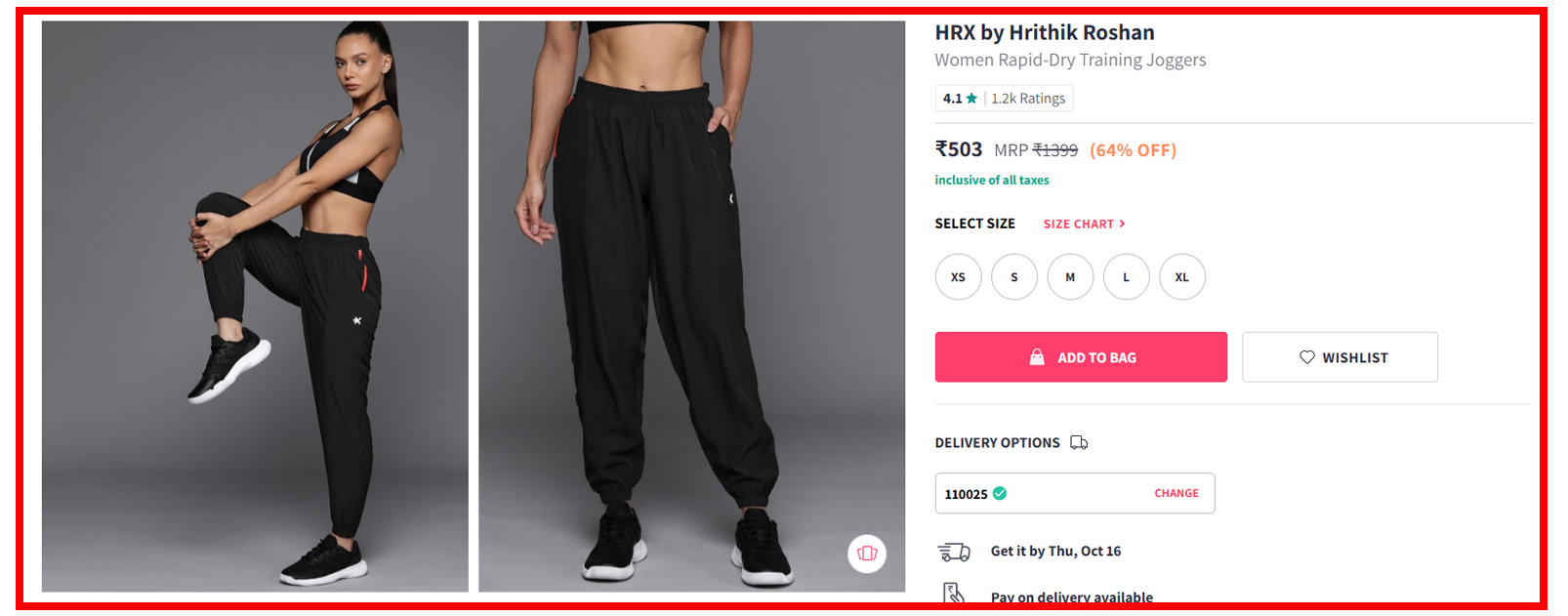
Notice their categorization hierarchy:
- Primary Category: Track Pants (not generic “Pants” or “Trousers”)
- Sub-category: Women’s Activewear
- Specific Type: Training Joggers
- Occasion Tags: Gym, Sports, Casual
- Feature Tags: Rapid-Dry Technology
Why HRX’s categorization works brilliantly:
- Appears in specific “track pants” searches
- Shows up in “activewear” browse sessions
- Captured by “training joggers” keyword searches
- Visible in gym wear filter selections
- Surfaces when customers filter by “quick-dry” or “moisture-wicking” features
The HRX Lesson:
They don’t try to cast a wide net by choosing “Women’s Bottoms” (too broad). They don’t miscategorize as “Yoga Pants” (not accurate). They choose the MOST SPECIFIC, MOST ACCURATE category: Track Pants > Training Joggers.
This precision means:
- Higher click-through rates (right audience)
- Better conversion rates (customers find exactly what they want)
- Lower return rates (accurate product expectations)
- Improved algorithmic ranking (Myntra rewards relevance)
The Category Selection Framework:
Ask yourself these questions:
- What would my ideal customer type in the search bar?
- Which filters would they use to narrow results?
- What is the MOST SPECIFIC category that fits my product?
Never choose broader categories hoping for more visibility. Myntra’s algorithm rewards specificity and relevance over breadth.
Action Step: Review your current listings. Are 100% of them in the most specific, accurate categories? If not, you’re leaving sales on the table.