
Blinkit's listing fee of Rs 25,000 per SKU per state is not a logistics cost. It is not a shelf rental. It is a media buy. The platform is selling you access to a consumer who already has their app open, their payment credentials saved, and is browsing a category you compete in right now.
That is the shift. And once you see it, the numbers make sense. Blinkit's ad revenue grew 220 percent year on year in Q3 FY24, more than double the rate its own orders grew. Zepto and Blinkit both crossed Rs 1,000 crore in annual advertising revenue by FY25. These are media businesses that happen to deliver groceries. The brands that understood this early are the ones winning category placement in 2026.
This guide covers how quick commerce advertising actually works, what it costs on each platform, and what you need to do to make it profitable rather than just active.
Why Quick Commerce Advertising Works Differently from Google and Meta
Every other channel has lag built into the purchase journey. A consumer sees your Google ad, clicks through, browses the site, maybe adds to cart, maybe comes back tomorrow. A Meta campaign builds awareness that may or may not convert weeks later. The gap between your ad spend and an actual sale is measured in days at best.
Quick commerce closes that gap entirely. Someone opens Blinkit at 7 AM wanting something for breakfast. Your sponsored product appears at the top of the category. They tap, add to cart, pay. The order arrives before they finish making tea. The entire journey from ad impression to purchase happens in a single session, in under 10 minutes, with no drop-off points in between.
That changes what you can measure. On Blinkit, you can see exactly which keyword drove a specific purchase, in which city, for which SKU, the same day. That kind of attribution does not exist on any other advertising channel in India at this price point.
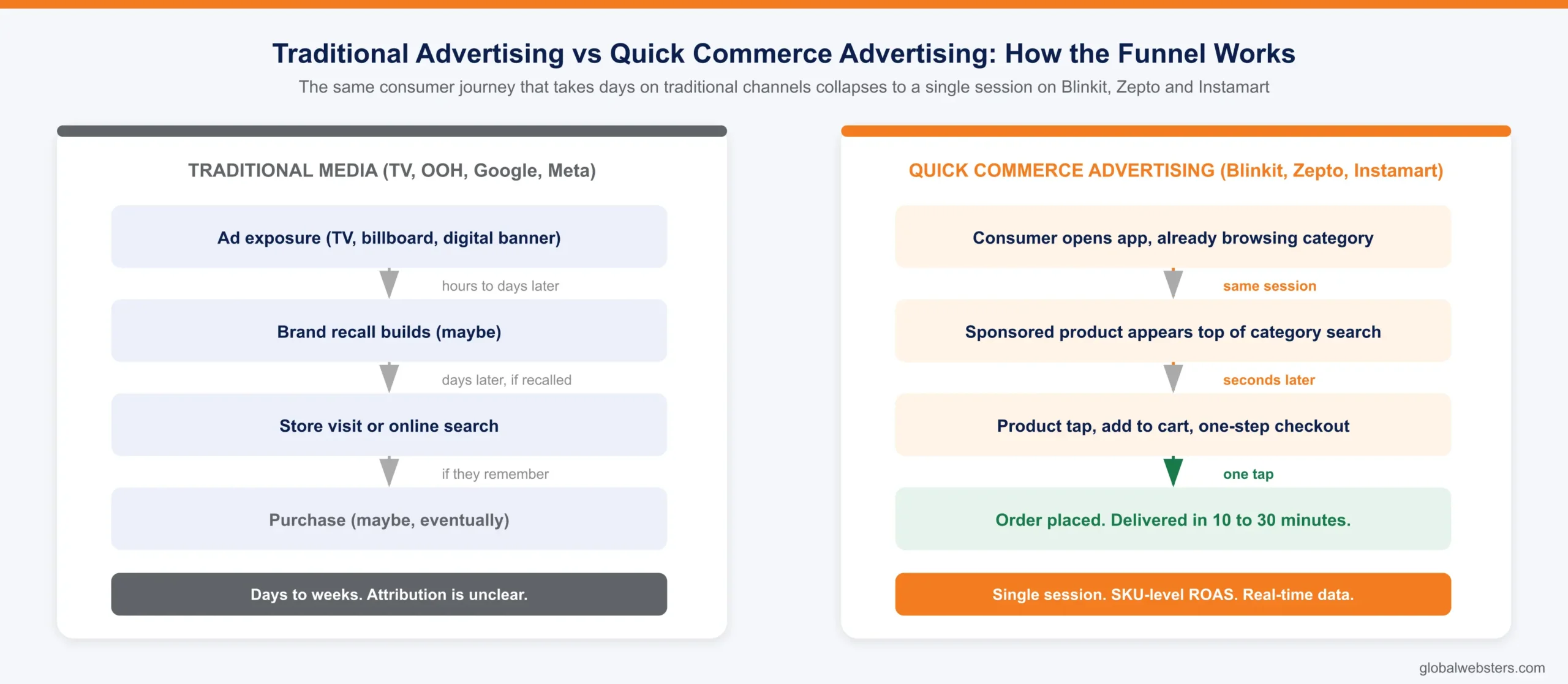
Blinkit's ad revenue grew 220 percent year on year in Q3 FY24, which was more than double its GMV growth. Both Blinkit and Zepto crossed Rs 1,000 crore in annual ad revenue by FY25. Advertising now makes up roughly 15 percent of Blinkit's total revenue. These platforms have built profitable media businesses alongside their delivery operations. Brands that treat them only as logistics channels are leaving significant competitive advantage on the table.
What Quick Commerce Advertising Actually Costs: Blinkit, Zepto and Instamart Compared
There is a lot of confusion around quick commerce costs because people mix up listing fees, logistics charges and advertising costs. Here is what each platform actually charges for advertising, broken down clearly.
These numbers look expensive until you compare them to other options. A billboard in Mumbai costs more and you cannot measure a single conversion from it. A Meta awareness campaign generates impressions that may never result in a purchase you can attribute. Quick commerce advertising goes directly to a consumer who is already in buying mode, and you can measure every rupee spent against actual orders at SKU level.
Both Zepto and Swiggy Instamart frequently calculate ROAS in their dashboards using Maximum Retail Price, not the actual selling price after platform discounts. If your MRP is Rs 500 but the actual price after discounts is Rs 340, your dashboard will show ROAS roughly 47 percent higher than your real return. Always recalculate ROAS manually using net transaction value before making any decision to scale spend. This is the single most common financial error brands make on these platforms.
For help calculating your actual margins, try the free Blinkit Profit Calculator from Global Websters.
Top of Cart vs Top of Mind: The New Objective for Brand Advertising
For decades, the goal of brand advertising was Top of Mind. Spend enough on awareness so that when a consumer eventually reaches a purchase decision, your brand is the one they think of first. It is a slow game, expensive, and hard to trace back to sales.
Quick commerce has created a more direct objective: Top of Cart. The brand that appears first in a category search at the moment someone opens the app is not competing for a future intention. It is competing for the next order placed in the next ten minutes.
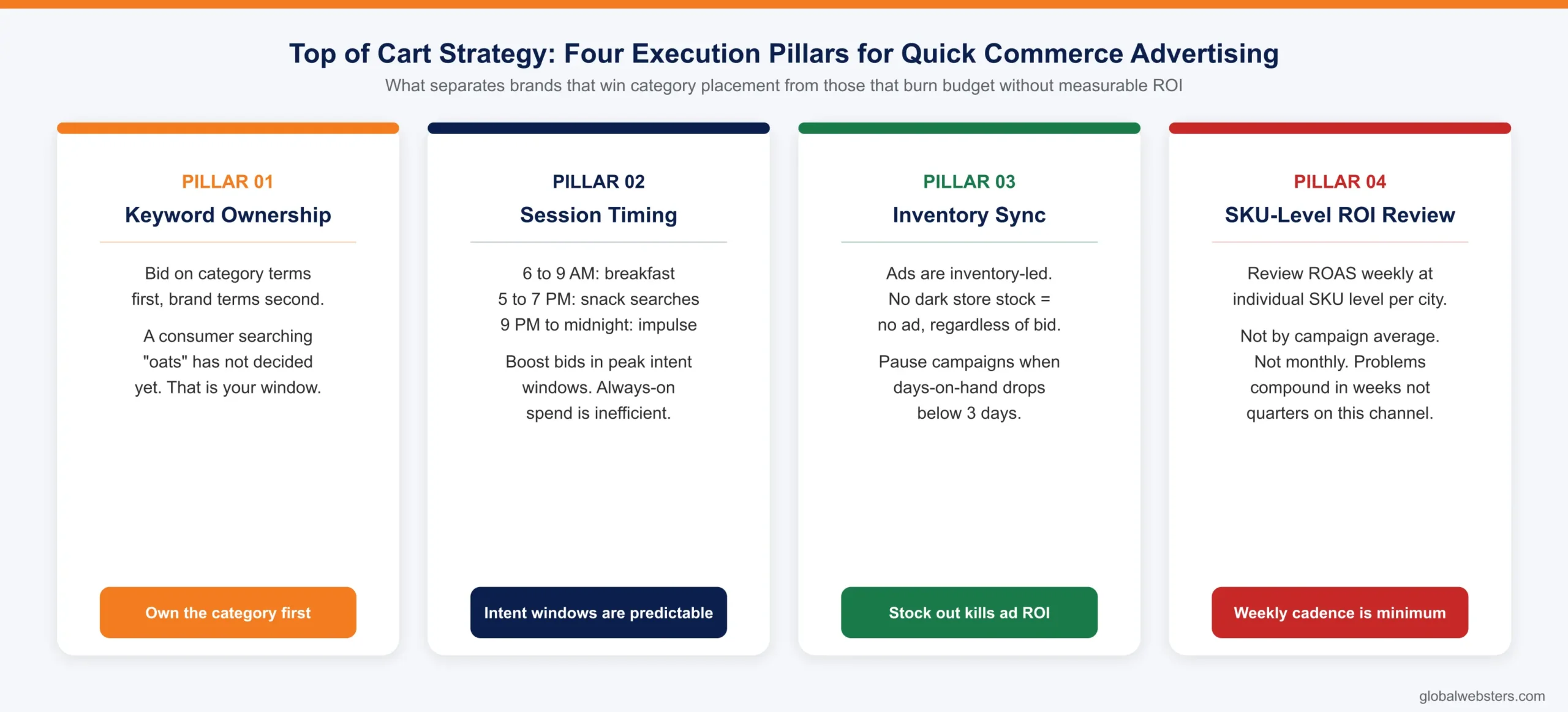
Winning Top of Cart comes down to four disciplines. Most brands are only doing one or two of them, which is why most quick commerce advertising spends more than it needs to.
- Category keyword ownership. You need to bid on generic category terms like "oats" or "face wash," not just your own brand name. A consumer who types "oats" has not decided which brand to buy yet. That is your opportunity.
- Session timing. Breakfast category searches spike from 6 to 9 AM. Evening snacks peak from 5 to 7 PM. Late-night impulse runs from 9 PM to midnight. Bidding at the same intensity all day is inefficient. Concentrate spend where intent concentrates.
- Inventory alignment. Blinkit's ad system only shows your product in areas where it is physically stocked in the nearest dark store. Running ads while out of stock does not just waste money. It damages perception.
- Weekly SKU-level review. A campaign that looks profitable at the category level can have individual SKUs losing money. Check at SKU level in individual cities, every week, not monthly.
How Blinkit Advertising Works: Formats, Costs and Campaign Setup
Blinkit is the most transparent platform for advertisers. Through Brand Central, the self-serve interface launched in December 2022, brands can set up and manage campaigns directly without going through an account manager. The Seller Hub also shows keyword search volume and conversion rate data by city before you spend anything, which no other quick commerce platform offers.
Before getting into format details, the most important thing to understand: Blinkit ads are inventory-led. Your sponsored product only appears in pin codes where your product is physically present in the nearest dark store. This is why many brands find their ads are not showing even though their wallet has balance. It is almost always a supply chain issue, not a campaign settings issue. Check dark store inventory first, every time.
Blinkit Ad Formats and When to Use Each One
| Ad Format | Where It Shows | Best Use Case | When to Start |
|---|---|---|---|
| Product Booster Performance | Top of keyword search results and category browse | Capturing consumers actively searching your category. Primary conversion format. | Day one. 80 to 90 percent of your ad budget should go here in the first 90 days. |
| Sponsored Brand Banner Reach | Top of category page, above organic results | Brand visibility within an audience already engaged in your category | Month 2 onwards once Product Booster data validates the category |
| Category Page Takeover Reach | Full-width banner across the category landing page | New product launches, seasonal campaigns, competitive defence moments | Planned campaigns only. Not suitable for always-on spend. |
| Brand Store | Dedicated page within the Blinkit app | Showcasing your full product range for consumers who want to explore the brand | Set up at launch, keep updated with offers and new SKUs |
Blinkit's Rs 25,000 listing fee is returned as Brand Central ad credits. Most brands sit on these and wait until they "understand the platform better." The right approach is to deploy them on the day the listing goes live as a Product Booster campaign mapped to the two or three keywords your Seller Hub analysis identified as highest opportunity. Brands that do this consistently get better early velocity numbers than those who wait. For a full walkthrough of listing setup, see the Blinkit Seller Onboarding Guide.
How Blinkit's Level System Connects to Ad Performance
Every new SKU starts at Trial level with under 100 units in one city. To reach Level 1, 2, 3 and eventually Level 4 (pan India), you need to hit specific sales velocity targets within rolling 30-day windows. Advertising accelerates this by driving early discovery and conversion that purely organic placements cannot achieve in the first few weeks. Reaching Level 2 and above expands your dark store coverage, which in turn makes your ads visible to more consumers in more pin codes.
For the complete breakdown of the Level system and how to progress through it, the Q-Commerce Growth Playbook covers each gate in detail.
Zepto Advertising: Swap and Save, Sponsored Products and Atom Analytics
Zepto works on a vendor and purchase order model. There is no self-serve portal like Blinkit's Seller Hub. Getting listed and running ads requires direct coordination with Zepto's category teams, so the timeline is longer. Factor in 4 to 8 weeks for the onboarding and approval process before you go live. Do not plan your Zepto launch around Blinkit's faster self-serve speed.
What Makes Zepto's Swap and Save Unique
Zepto has one ad format that no other quick commerce platform in India offers: Swap and Save. When a consumer adds a competitor's product to their cart, Zepto shows them your product as a better-value alternative, with a single tap to switch. The consumer has already decided to buy the category. You are only redirecting which brand they buy.
This is the highest purchase-intent ad format on any Indian quick commerce platform. It works best for brands that have a clear pricing advantage, strong name recognition in the category, or a compelling product difference relative to the incumbent. If you have at least one of those three things, Swap and Save is worth testing as soon as it becomes available in your category.
Zepto onboarding requires direct coordination with their category teams. Budget 4 to 8 weeks for the relationship-building and approval phase. This is a managed vendor process, not a self-serve registration. Plan your Zepto entry timeline accordingly, and use the time to solidify your Blinkit operations so the learnings carry across cleanly.
Is Zepto Atom Worth Rs 30,000 Per Month
Zepto Atom is a subscription data platform giving you real-time Share of Voice tracking against Market Leaders and your Closest Competitors, search volume data and consumer profiling. At Rs 30,000 per month, it is a useful tool at the right stage, but it is easy to invest in it too early.
If your Zepto revenue is still in early validation, that Rs 30,000 is better spent on actual advertising. Atom becomes genuinely valuable when you are generating meaningful Zepto revenue, you have close competitors, and you need weekly SOV data to make smarter budget allocation decisions. At that point, the cost is proportional to what it informs.
- Zepto is generating meaningful revenue and you are defending category share
- You have 2 or 3 close competitors with regular Share of Voice shifts
- Your team can act on SOV data on a weekly basis
- The monthly cost is proportional to the Zepto budgets it informs
- Early-stage Zepto with limited revenue established yet
- Ad budget is better used on actual campaigns than analytics tooling
- Team does not have weekly bandwidth to act on the data
- Blinkit unit economics not yet proven — get that right first
Swiggy Instamart Advertising: The Food Ecosystem Advantage and Quarterly Brand Pack
Instamart has a structural advantage that most brands do not fully appreciate: a large share of its shoppers are Swiggy food delivery users encountering Instamart within the same app they already use to order food. They have saved payment credentials. They have an established purchase habit. They have brand familiarity from the food side that extends naturally to grocery and household purchases on Instamart. Swiggy added over 316 dark stores in Q4 FY25 alone, expanding to 124 cities, which shows how seriously they are scaling this cross-ecosystem position.
The Rs 8 to 10 lakh quarterly brand pack bundles display ads, push notifications and featured category placement. For established FMCG brands with existing name recognition in Swiggy's base, this is efficient because you are reinforcing a brand consumers already know. For new or emerging brands with no awareness in Swiggy's ecosystem, the same pack delivers weaker results because consumers who do not recognise the brand will not click the placement regardless of how prominently it is positioned.
- Established brand with recognition in Swiggy's food delivery user base
- Food-adjacent category with natural crossover to Instamart shoppers
- Blinkit is already stable and unit economics are validated
- Budget committed for the full 3-month run, not treating it as a test
- Dark store inventory capacity in place for a potential demand surge
- Zero brand awareness in Swiggy's user base
- Blinkit margins and unit economics not yet proven
- Supply chain cannot handle multi-platform dark store coverage at once
- Team does not yet have operational capacity for a third platform
- Category has no meaningful food delivery audience overlap
How Brands Win on Quick Commerce Advertising: The Precision Approach
The Saffola Oats example on Blinkit is worth understanding in detail because it illustrates what precision actually looks like in practice. The strategy is not complicated. They own category search terms including "oats" and "healthy breakfast" during the 6 to 9 AM window when breakfast searches peak. The ad fires. The consumer adds to cart. The purchase completes. The ROAS is measured at the Saffola Oats SKU level, in the specific city, for that specific keyword, in that specific time window.
That is what separates brands building profitable quick commerce advertising from brands running expensive always-on campaigns and checking results quarterly. The gap is not budget. It is precision and review cadence.
Own the category term, not just your brand name. Bid on "oats" before "Saffola Oats." Intercept consumers who have not yet decided on a brand.
Concentrate spend in peak intent windows. Breakfast searches spike 6 to 9 AM. Evening snacks peak 5 to 7 PM. Do not run uniform spend across all 24 hours.
Review ROAS at SKU level, in individual cities, every week. Not by campaign. Not by category average. Problems compound quickly on this channel.
Sync your inventory with your campaign calendar. An ad firing to an out-of-stock product does not just waste the spend. It harms brand perception at the most important moment.
The Platform House Brand Problem and How to Compete Against It
There is one aspect of quick commerce advertising that does not get discussed enough: the platforms are building their own brands inside the same ecosystem. Zepto's Go Zero competes in categories where third-party brands advertise, but with structural advantages that no amount of advertising spend can match. Zero listing fees. Preferential dark store placement. Access to first-party consumer data that external brands pay Rs 30,000 per month through Atom to approximate.
This is not unique to quick commerce. Amazon built AmazonBasics for years. What is different here is the speed and the proximity. Go Zero does not sit in a separate category. It sits directly above your product in the same category search result, in placement that standard bidding cannot displace.
Platform house brands will always win on placement inside their own ecosystems. What they cannot have is an authentic brand story, a community of customers who chose you rather than defaulted to you, or a product developed around genuine consumer needs rather than platform optimisation. Build those things deliberately, alongside your advertising discipline. That combination is the moat platform house brands cannot replicate through any amount of internal advantage.
For the full context on how brand building on Amazon supports your quick commerce conversion, see: The Q-Commerce Growth Strategy guide which covers the Amazon-to-Blinkit credibility signal in detail.
Before You Spend a Rupee on Quick Commerce Advertising: Five Things That Must Be in Place
Most quick commerce advertising waste comes from launching too broad, too early, without the right foundation. The five steps below address the two failure modes that cause most of the budget waste: launching before inventory is confirmed, and not having the attribution infrastructure to catch problems before they compound.
Run the Blinkit Seller Hub Keyword Analysis Before Paying the Listing Fee
The Seller Hub shows keyword search volume and conversion rate signals by city, free of charge, before you pay Rs 25,000 for a listing. Spend at least a week here before committing. High Search plus Low Conversion is your best entry quadrant because demand exists but current products are underperforming. High Search plus High Conversion means you are entering a competitive battleground and need a clear advantage. For the full Seller Hub framework, see the Q-Commerce Growth Playbook.
Confirm Dark Store Stock Is Live Before Switching On Any Campaign
Blinkit's ad delivery is inventory-led. Your ads only show in pin codes where your product is in the nearest dark store. Running a campaign before stock is confirmed in dark stores burns money on impressions that can never convert. This is also the most common reason why new brand ads do not show despite available wallet balance. Verify dark store distribution before activating anything, and check at city level, not just nationally.
Map Intent Windows for Your Category Before Writing a Bidding Schedule
Not all hours deliver equal purchase intent. Breakfast categories peak from 6 to 9 AM. Snacks run from 5 to 7 PM. Late-night impulse happens from 9 PM to midnight. Grocery replenishment tends to peak on weekend mornings. Build a simple time-of-day map for your specific category before you set bid adjustments. Running flat bids all day is not a neutral strategy. It wastes budget during low-intent periods at the expense of high-intent ones where you should be most visible.
Set Up Weekly SKU-Level Reporting Before the First Campaign Goes Live
The most expensive quick commerce advertising mistake is discovering a loss-making SKU at the quarterly business review. Build a weekly reporting structure that tracks ROAS at individual SKU level in individual cities before you launch. This is not a response to problems. It is the infrastructure that prevents problems from compounding over weeks without being caught. For the full set of metrics to track, the Q-Commerce Growth Playbook covers all five weekly metrics in detail.
Validate Contribution Margin Before Scaling Any Ad Spend
Quick commerce needs 60 to 70 percent gross margins to absorb platform commission, fulfilment fees, storage costs and advertising spend and still deliver a positive contribution. Calculate this per SKU, per city, before deciding how much to advertise. Brands that scale advertising before validating margin are accelerating losses, not revenue. If the margin does not work at current spend levels, more spend will make the problem worse faster. The Blinkit Profit Calculator is a quick way to check your numbers before committing.
The Right Order to Launch Advertising Across Blinkit, Zepto and Instamart
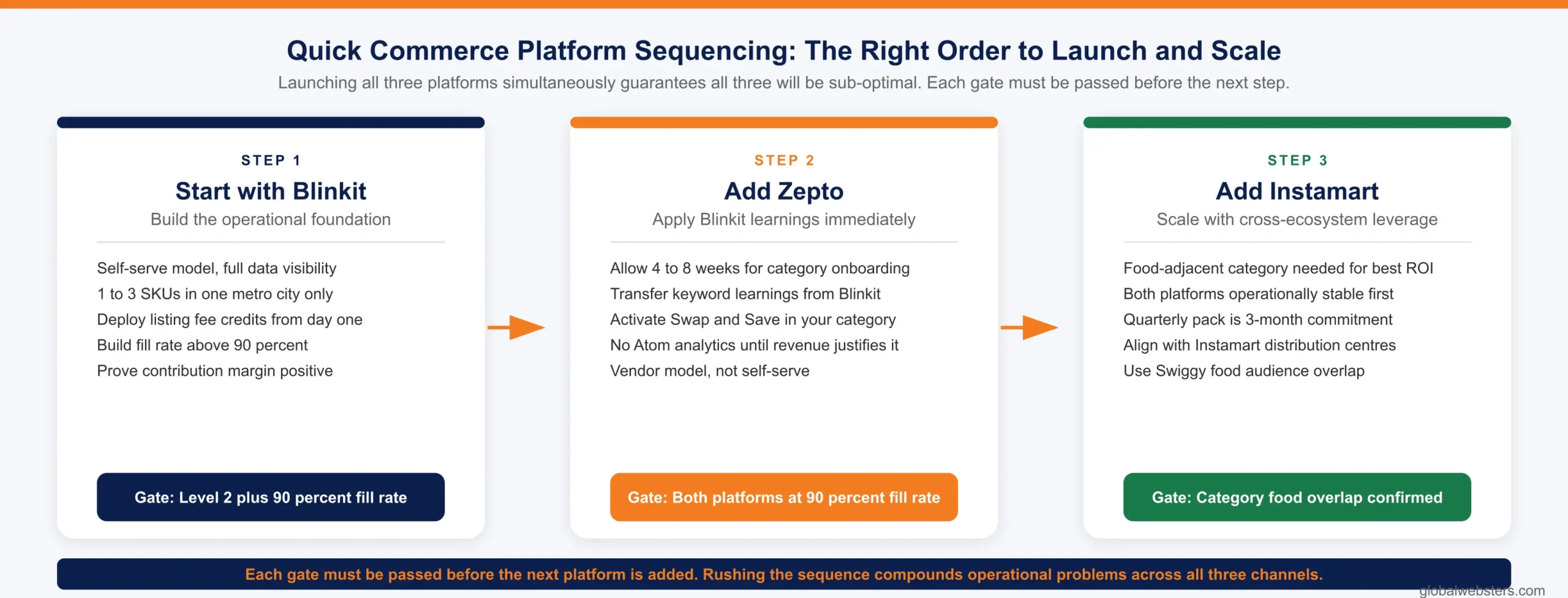
The most common operational mistake brands make is launching advertising across all three platforms at once. The ad management, inventory operations and account relationships are all different on each platform. Running them in parallel before any single one is stable guarantees that all three will be sub-optimal and none will be profitable.
Blinkit: Build the Foundation
- Self-serve model gives full data visibility from day one
- Start with 1 to 3 hero SKUs in one metro city
- Deploy listing fee credits as Product Booster campaigns on launch day
- Build fill rate above 90 percent before scaling spend
- Prove contribution margin is positive at current spend level
- Gate: Blinkit Level 2 reached and fill rate above 90 percent consistently
Zepto: Apply What Blinkit Taught You
- Transfer keyword, city and SKU learnings directly from Blinkit
- Begin category team onboarding, allow 4 to 8 weeks lead time
- Activate Swap and Save against the top competitor in your category
- Hold off on Atom analytics until Zepto revenue justifies the cost
- Gate: both platforms at 90 percent fill rate and positive contribution margin
Instamart: Scale With Cross-Ecosystem Reach
- Evaluate only if the category has natural food delivery audience overlap
- Both platforms must be operationally stable before adding a third
- The quarterly pack is a 3-month commitment, plan accordingly
- Align dark store coverage with Instamart distribution centre locations
- Leverage any existing Swiggy food brand recognition as a conversion advantage
For the full 90-day plan with fill rate targets, inventory management and unit economics frameworks across all three platforms, read the Q-Commerce Growth Playbook for Blinkit, Zepto and Swiggy Instamart. If you want hands-on support managing the launch process, the Quick Commerce Enablement service from Global Websters handles every step from listing to live advertising.
Quick Commerce Advertising FAQs: Blinkit, Zepto and Instamart
Need a Quick Commerce Advertising Strategy That Actually Delivers ROAS?
Global Websters has helped brands at every stage of the quick commerce journey, from first Blinkit listing to managing profitable ad campaigns across all three platforms. Whether you are building your first playbook or trying to fix a strategy that is burning budget without results, the Quick Commerce Enablement team has the operational and strategic experience to build it with you. You can also check if your overall go-to-market strategy is aligned before diving into platform advertising.