
Flipkart stopped charging commission on every product priced under ₹1,000 in November 2025, and in July 2026 extended zero commission to all fashion products regardless of price point. Together, these two shifts have changed how thousands of Indian sellers price their catalogues.
The flipkart seller fees and rate card 2026 structure involves four separate deductions on every delivered order, and they stack silently. At Global Websters, we manage over 500 Flipkart seller accounts across fashion, home, electronics, and FMCG categories. The patterns we see in settlement reconciliation every week informed every section of this guide. Sellers who want end to end support can explore our Flipkart seller account management service for full account growth and fee optimisation.
July 2026, against Flipkart Seller Hub fee documentation and live seller account data.
Flipkart Seller Fees at a Glance (2026)
| Fee Type | How It Is Charged |
|---|---|
| Commission (Referral Fee) | Percentage of selling price, varies by category. Zero for eligible products under ₹1,000 |
| Fixed Fee (Closing Fee) | Flat per order charge, set by price slab and seller tier |
| Collection Fee | Payment processing charge. Roughly 1.8% to 2% for prepaid orders, and 2% to 3% for COD orders |
| Shipping Fee | Based on actual or volumetric weight, and dead weight |
| GST on All Marketplace Fees | 18% charged on every fee line above |
Verify your exact rate card at Flipkart Seller Hub, under Fees and Commission. Rates differ by seller account, category and price band.
What Fees Does Flipkart Actually Charge Sellers in 2026
Most sellers who come to us have been running their accounts for months and still do not have a clean number for what Flipkart actually takes per order. That is not a budgeting problem. That is a structure problem.
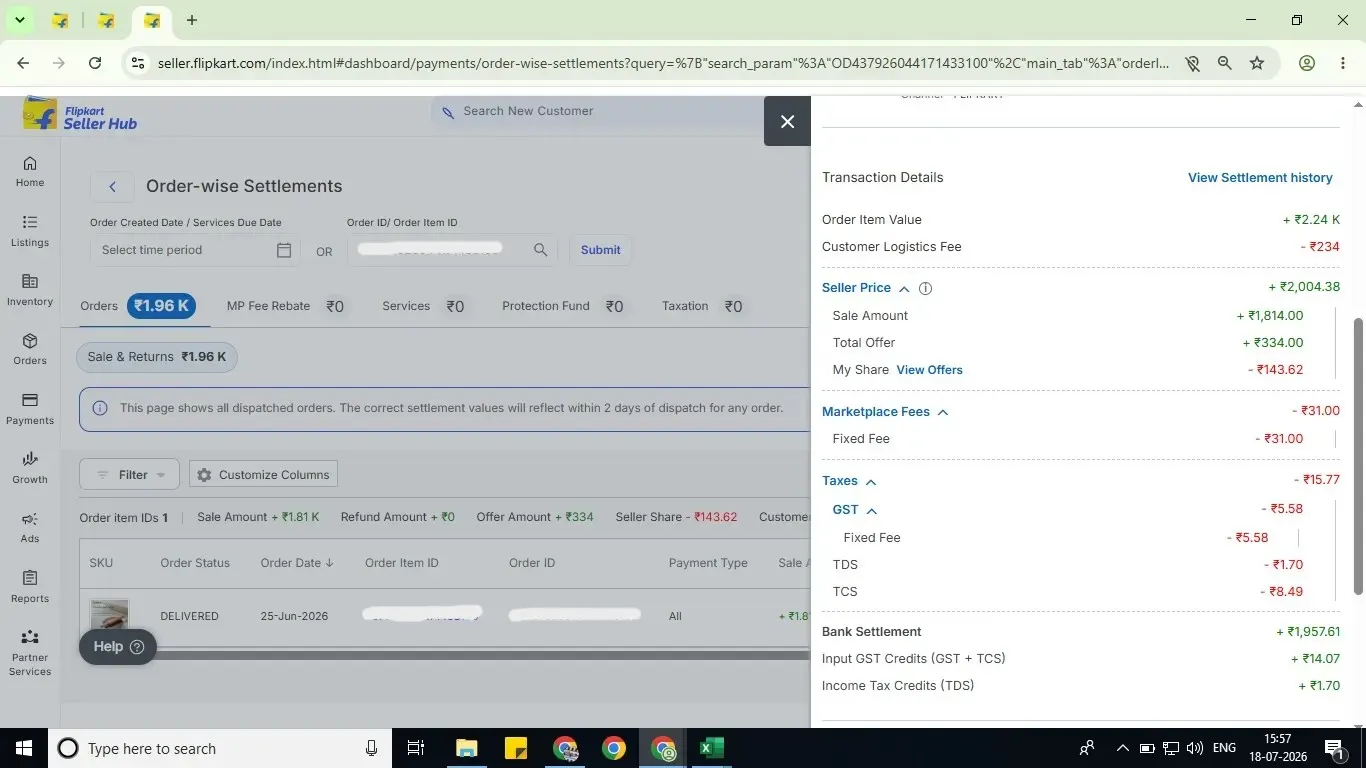
Flipkart's flipkart seller charges stack in four layers on every delivered order: commission, fixed fee, collection fee, and shipping fee. GST at 18% is applied on top of each layer separately. There is also a reverse logistics fee whenever a customer returns a product, and this one gets silently absorbed more than any other line item we see in settlement audits.
Across the 50+ Flipkart accounts we manage at Global Websters, the single most common margin error is sellers calculating profitability against the commission rate alone, ignoring fixed fee, collection fee, and zone weighted shipping. A product that shows a 30% margin on a basic calculation typically nets 12% to 15% in actual settlement, depending on tier, zone, and payment mode. We have seen sellers running entire categories at a loss for months before a settlement audit revealed the real numbers.
For sellers who want expert help managing your Flipkart seller account, fee reconciliation and settlement verification is almost always where the biggest immediate cash recovery happens.
Flipkart Commission Fee by Category, Explained
Commission, also called the referral fee, is the percentage Flipkart deducts from your selling price before any other calculation. It is the largest variable in your cost structure and differs significantly across categories. The most important thing to understand first: since November 2025, products priced under ₹1,000 attract zero commission across all eligible categories. As of July 2026, Flipkart has also extended zero commission to all fashion products regardless of price point. For all other categories, the rates below apply to products priced above ₹1,000.
Indicative Commission Rates by Category (2026)
| Product Category | Under ₹1,000 | Above ₹1,000 |
|---|---|---|
| Mobiles and Smartphones | 0% | 2% to 5% |
| Consumer Electronics | 0% | 5% to 9% |
| Laptops and Accessories | 0% | 5% to 8% |
| Home and Kitchen | 0% | 8% to 14% |
| Fashion and Apparel | 0% | 0% |
| Fashion Jewelry | 0% | 0% |
| Beauty and Personal Care | 0% | 10% to 15% |
| Sports and Fitness | 0% | 7% to 12% |
| Books | 0% | 8% to 12% |
| FMCG and Grocery | 0% | 3% to 8% |
Fashion and Apparel and Fashion Jewelry show 0% above ₹1,000 because Flipkart extended zero commission to all fashion price points in July 2026.
These are indicative ranges for the above ₹1,000 column. Your exact rate depends on your specific sub category and the rate card attached to your seller account. Rates vary within a category, so a sub category under Home could sit at 8% while another sits at 14%. Always confirm your current rate in the Flipkart Seller Hub under Fee Structure, especially after any rate revision notification from Flipkart.
Flipkart charges 18% GST on the commission amount itself. If you are GST registered, which is mandatory to sell on Flipkart in most categories, you can claim this back as input tax credit, making it a recoverable cost.
To avoid guessing at a category average, calculate your exact commission and payout here before finalising your MRP. Getting this right at the listing stage saves significant pain in settlement reconciliation later.
The 0% Commission Rule for Products Under ₹1,000 and Now All Fashion
This is the most significant change to the Flipkart fee structure in recent years. In November 2025, Flipkart announced a zero commission policy on eligible products priced below ₹1,000. Alongside this, its value platform Shopsy moved to a blanket zero commission model across all price points. The change was confirmed and in full effect by early 2026.
On July 8, 2026, Flipkart expanded this further, removing the ₹1,000 price ceiling entirely for fashion. All fashion products, including premium clothing, footwear, and accessories, now carry zero commission regardless of price point. The move benefits approximately 90,000 active fashion sellers on the platform.
Flipkart stated the combined effect of the commission waiver and a concurrent reduction in return fees could lower the total cost of doing business for affected sellers by up to 30%.
What This Means Practically for Sellers
From the accounts we manage, sellers who repriced SKUs to fall just under ₹1,000 after this policy change saw immediate improvement in net settlement per unit. A product priced at ₹1,050 in a non fashion category with a 15% commission loses ₹157.50 in commission before any other fee. The same product repriced at ₹999 loses zero commission. The net payout is often higher at the lower price point once you factor in fixed fee and shipping.
For fashion sellers specifically, this repricing calculation no longer applies, since zero commission now covers all fashion price points as of July 2026. The margin previously lost to commission can instead be reinvested into visibility or pricing competitiveness without needing to adjust MRP downward.
For sellers on Shopsy specifically, the zero commission model now applies at every price point. Shopsy's buyer base is concentrated in tier 2 and tier 3 cities, and most products on the platform price between ₹150 and ₹250. At those price points, even a small commission rate was taking a disproportionate share of margin. The margin you save from zero commission is often best reinvested into visibility. Our Flipkart advertising guide explains how to spend on PLA and PCA ads without giving that saved margin straight back.

Flipkart Fixed Fee and Platform Fee, What is the Difference
These two terms still appear interchangeably in some seller guides, but as of Flipkart's 2024 fee structure simplification, they are one and the same line item. What used to appear as a separate tech fee or platform fee was folded into the fixed closing fee. What you see on your settlement report today is simply the fixed fee, charged once per successfully delivered order.
How the Fixed Fee Works
Unlike commission, the fixed fee is not tied to product category. It is determined by two things: your product's selling price slab, and your seller tier (Bronze, Silver, Gold, or Platinum). Bronze sellers pay the highest fixed fee, and Platinum sellers pay the lowest, with the difference per order running roughly ₹5 to ₹25 depending on the price slab.
At volume, that gap becomes meaningful. We have seen sellers move from Bronze to Gold tier and save between ₹15,000 and ₹40,000 per month purely on fixed fee reduction, without changing a single product listing or selling price. Climbing tiers is directly a margin lever, not just a platform badge.
FBF orders, where Flipkart handles storage, packing, and dispatch, typically carry a lower fixed fee than NFBF self ship orders, since Flipkart absorbs part of the handling cost. Confirm current fixed fee slabs in your Flipkart Seller Hub, since exact rupee values vary by seller agreement and are updated periodically.
Flipkart Collection Fee, COD vs Prepaid
The flipkart collection fee is the charge Flipkart applies for processing the customer's payment on your behalf. This fee applies to all orders, both prepaid and COD. For prepaid orders, the collection fee is approximately 1.8% to 2% of the order value. For COD orders, it is approximately 2% to 3%.
COD costs more because of what it involves operationally: physical cash collection at the doorstep, courier handling of cash, and a higher risk of failed delivery or non collection. Confirm exact rates in your Flipkart Seller Hub rate card as figures vary by seller account.
The customer pays the same MRP whether they choose COD or prepaid. The extra collection fee for COD comes entirely out of the seller's settlement. The seller receives nothing extra from a COD transaction. They simply net less per order.
For sellers running high COD volumes, particularly common in tier 2 and tier 3 cities where Flipkart and Shopsy both do heavy business, this difference adds up across thousands of orders per month. We have seen accounts where shifting buyer behaviour toward prepaid, through pricing incentives or promotional design, recovered ₹20,000 to ₹50,000 per month in net settlement without any change to catalogue or MRP. This kind of COD to prepaid optimisation is part of what our Flipkart account management service does for the accounts we run.
Check your own COD to prepaid ratio in the Seller Hub. If COD is a large share of your orders, model both scenarios against your actual order mix. Confirm exact collection fee rates in your current rate card at Flipkart Seller Hub, under Fees and Commission, since rates vary by seller account and price band.

Flipkart Shipping Charges by Weight
Shipping is calculated on whichever is higher: actual weight of the packed product, or its volumetric weight. Volumetric weight is calculated as length multiplied by width multiplied by height in centimetres, divided by 5,000. A light but bulky product, a cushion cover, a travel pillow, a decorative lamp, often gets charged on volume rather than actual weight. This catches sellers off guard the first time they see it on a settlement report.
Three Delivery Zones, Three Price Points
Zone determines the shipping cost as much as weight does.
Delivery within the same city is the cheapest of the three zones.
Delivery within a region costs more than local movement.
Delivery across India costs the most of the three zones.
Items under 500 grams moving within local and zonal zones generally do not attract additional shipping charges under Flipkart's current simplified delivery rules, though this is subject to category and policy at the time of listing, so confirm before pricing new SKUs.
A seller shipping the same product to a customer in the same city versus a customer in a different region can see a meaningfully different net payout from what looks like an identical sale. If your customer base is geographically spread, build a zone weighted average shipping cost into your MRP rather than a single flat number. For heavy or bulky products, this single step often reveals that certain national deliveries are genuinely loss making at the current MRP.
Flipkart Seller Payment and Settlement Terms
Understanding the flipkart seller payment terms is a working capital question as much as a fee question. Flipkart does not pay you the moment a customer buys. Settlement runs on a tiered cycle from the point of dispatch, specifically from when the courier scans your package at the first mother hub.
Settlement Cycle by Tier (2026)
| Seller Tier | Typical Settlement Period |
|---|---|
| Diamond | Around 2 business days from delivery |
| Gold | Around 3 business days from delivery |
| Silver | Around 10 business days from delivery |
| Bronze | Around 15 business days from delivery |
Payments are released on Mondays, Wednesdays, and Fridays. Once released, funds typically appear in your bank account within 24 to 48 working hours, depending on your bank's NEFT processing schedule. The settlement calculation covers the selling price minus all applicable deductions, with each delivery order settled separately.
Two additional deductions that are not platform fees but that reduce your settlement amount are TCS (Tax Collected at Source) at 1% under GST Section 52 of the CGST Act, and TDS under income tax rules. Flipkart deducts and files these on your behalf. Both are fully recoverable when you file your GST returns and ITR, and they will appear in your GSTR-2B for TCS. They do reduce the immediate cash hitting your account, so factor them into working capital planning.
If a return is unjustified, an item comes back damaged, or an empty box return is filed, you can raise an SPF claim within 14 days of receiving the return. Across the accounts we manage at Global Websters, sellers who were unaware of SPF before working with us have recovered between ₹5,000 and ₹80,000 in a single month once they started filing systematically. Learn more about SPF at the Flipkart Seller Hub FAQ.
Flipkart Return and Reverse Logistics Fee Impact
Returns are where quiet, systematic margin loss lives. When an order is returned, Flipkart generally reverses the commission it charged on that sale. The fixed fee is only charged on delivered orders, so there is nothing to reverse there. What you do absorb is the reverse logistics fee for the returned shipment, plus the cost of restocking, repackaging, or writing off the item.
As part of the same policy update that introduced the zero commission band under ₹1,000, Flipkart reduced return fees by roughly ₹35 across several categories, bringing typical return charges down to the ₹160 to ₹175 range in affected categories. Confirm the exact figure for your category in your current rate card.
In the fashion accounts we manage, return rate is the single biggest gap between projected margin and actual payout. We track return rates weekly for every SKU, and anything above 18% triggers a listing audit before any pricing review. For fashion and footwear sellers running return rates of 20% to 30%, even a ₹35 reduction per return has a measurable effect on blended margin across a full month's volume. At 500 returns in a month, that is ₹17,500 back in the account.
If returns are eating into a specific SKU's margin, the first fix is almost always listing quality, not pricing. In our account management work, inaccurate size charts, misleading product images, and vague descriptions account for over 60% of avoidable returns we see across Flipkart fashion accounts. Fixing listing accuracy before repricing is consistently the higher ROI move.
For the complete breakdown of FBF warehouse charges, storage fees, customer return costs by category, and a step by step SPF claim process, read our Flipkart FBF and return charges complete guide.
How Flipkart Fees Compare to Amazon and Myntra
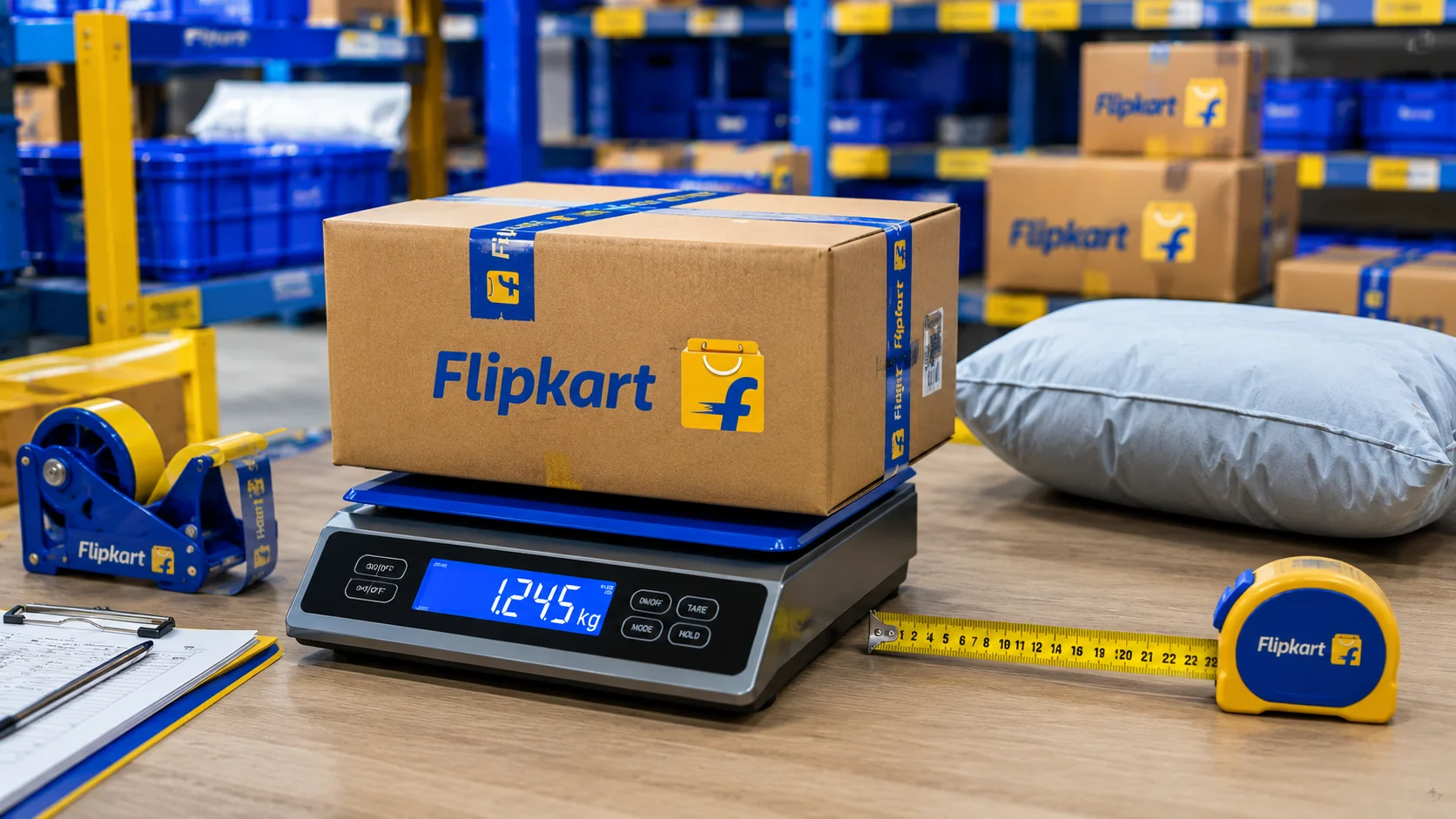
The three largest fashion and general merchandise platforms in India, Flipkart, Amazon, and Myntra, all run multi component fee structures, but the numbers and norms differ enough to affect product level pricing decisions meaningfully.
Fee Comparison: Flipkart vs Amazon vs Myntra (2026)
| Fee Type | Flipkart | Amazon | Myntra |
|---|---|---|---|
| Commission | 0% to 22% by category | 0% to 25% by category | 10% to 30%, fashion focused |
| Fixed / Closing Fee | Tier based, per delivered order | Category based per order | Category and tier based |
| Fulfilment Program | FBF | FBA | MVF (Myntra Vendor Fulfilment) |
| Collection Fee (COD) | 1.8% to 2% prepaid, around 2% to 3% COD | Higher than prepaid | Lower COD penetration |
| Settlement Cycle | 7 to 15 days, tier based | 7 to 14 days | 7 to 15 days |
| Return Rate (Fashion) | 20% to 30% | 15% to 25% | 25% to 35% |
| 0% Commission | Yes, under ₹1,000 plus all fashion | Yes, under ₹1,000 (from March 2026, 1,800+ categories) | No |
| GST on Fees | 18% | 18% | 18% |
Both Flipkart and Amazon now run a zero commission model for products under ₹1,000. Flipkart introduced this in November 2025, and Amazon followed platform wide in March 2026, expanding zero referral fees to over 12.5 crore products across 1,800+ categories. The real differentiator between the two platforms in 2026 is fixed fee structure, settlement speed, return rates by category, and fulfilment program cost, not commission on low priced products. Myntra remains commission based at all price points.
Return rates are the hidden fee on all three platforms. A seller with a 25% return rate on Myntra is effectively paying reverse logistics on one in four orders. If you are listing the same product across Flipkart, Amazon and Myntra, compare fees across other marketplace calculators before setting a single national MRP, since the same price can yield very different net margins depending on the platform. For worked category level examples, see a full pricing comparison across Amazon, Flipkart and Myntra.
How to Calculate Your Actual Flipkart Payout
The settlement formula sounds straightforward until you run it with real numbers.
Net Settlement = Selling Price − Commission − Fixed Fee − Shipping Fee − Collection Fee − GST on all fees
Net Profit = Net Settlement − Cost of Goods (COGS)
Worked Example: ₹799 Home Product, Gold Tier, National Delivery, Prepaid
| Line Item | Amount (Indicative) |
|---|---|
| Selling Price | ₹799 |
| Commission (0%) | −₹0 |
| Fixed Fee (Gold tier, ₹500 to ₹1,000 slab) | −₹12 (indicative) |
| Shipping Fee (National, 500g) | −₹131 (indicative) |
| Collection Fee (prepaid, around 2% of ₹799) | −₹16 (indicative) |
| GST on fees (18% on fees) | −₹29 (indicative) |
| Net Settlement | Around ₹611 (indicative) |
This is before COGS. A product with a ₹400 landed cost leaves roughly ₹211 per unit at Gold tier on a prepaid national order. The same product at a Bronze tier pays a higher fixed fee and waits longer for settlement. The same product sold COD pays a higher collection fee. Swap any one variable and this number moves.
Running this manually for a catalogue of 50 or 100 SKUs is not realistic. Use the free Flipkart fee calculator and adjust for your actual seller tier, fulfilment method, delivery zone, and payment mode, so every listed price reflects your real margin rather than a rough estimate. The worked example above is indicative only. Confirm your exact fixed fee, collection fee, and shipping rate in your Flipkart Seller Hub rate card before finalising pricing.
Once your baseline numbers are clear, the next step is actively bringing those deductions down. Our guide on how to reduce Flipkart seller fees covers tier upgrade strategy, COD to prepaid conversion, shipping weight optimisation, and pricing tactics that directly improve per order net margin.
Frequently Asked Questions
What to Do Next
Audit your last 30 days of settlement reports
Pull the reports and check three things:
- Your current seller tier
- Your actual blended commission rate across categories
- Your return rate by SKU
Run your highest volume SKUs through the calculator
Take those SKUs through the Flipkart seller price calculator and verify the payout against what you are seeing in settlement.
Investigate any gap larger than 2% to 3%
If the gap between expected and actual is larger than 2% to 3%, that is the conversation to start first.
And if under ₹1,000 repricing has not been reviewed since November 2025, now is the right time. If you sell fashion at any price point, the July 2026 zero commission expansion means your margin calculations need revisiting today.
Stop guessing what Flipkart is deducting from every order
We reconcile settlements, audit rate cards, file SPF claims and rebuild pricing for over 500 Flipkart seller accounts. Start with a free fee audit of your account with the Global Websters team.